Start a Project
What we do
Capabilities Services Industries
Work
Company
About Careers Contact
Start a Project
Selected work 05

NIBRA-CS — a portable instrument for autonomic neurofunction assessment.

A diagnostic instrument that runs the full battery of cardiac autonomic reflex tests at the point of care, with no computer attached and no specialist required to run it. The client had a prototype on the bench that barely ran. We developed the firmware, the embedded software and the touchscreen product, and took it to the point where units could be built in numbers and installed in hospitals for trials.
Client
Inovocare Healthsoft Solutions
Industry
Healthcare and medical technology
Stage at start
Bench prototype, barely working
Volvix Systems role
Firmware, embedded software and product interface
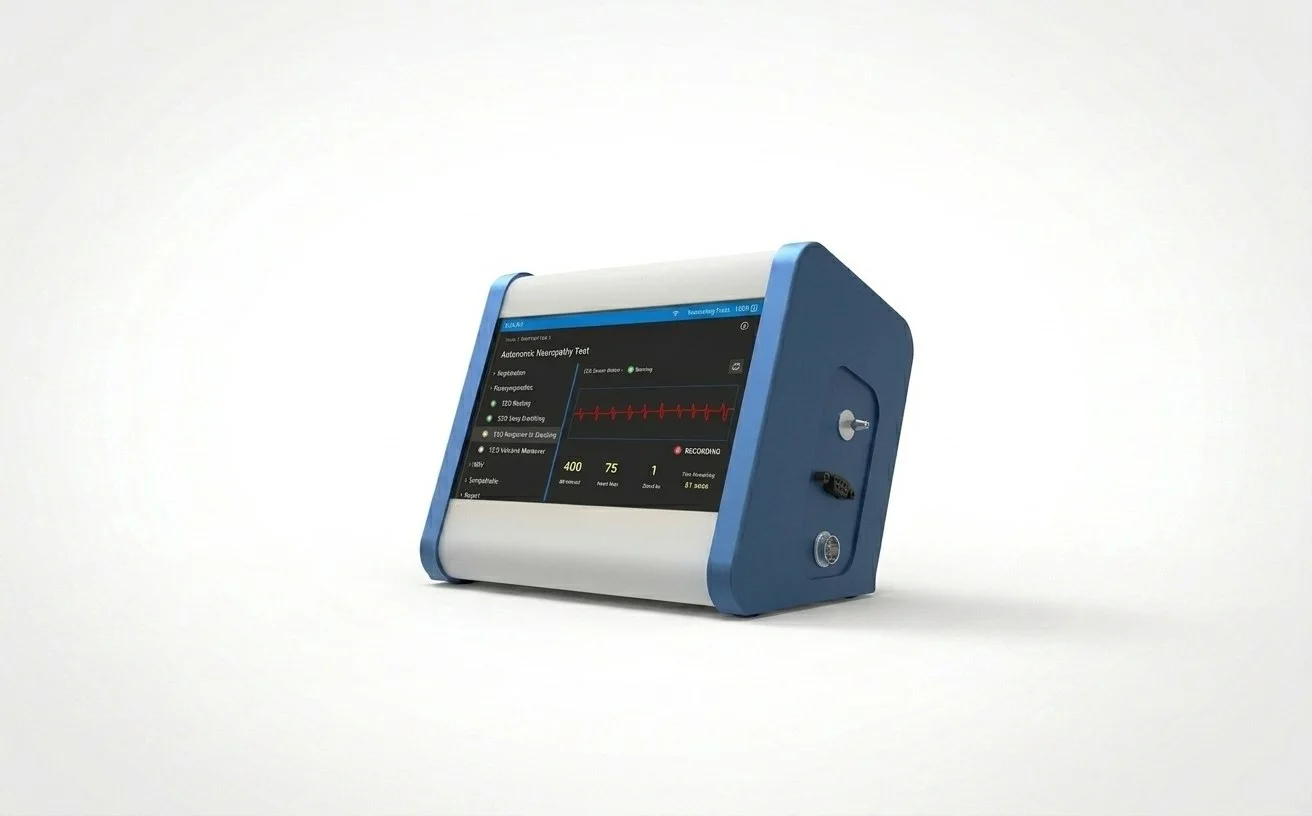
The NIBRA-CS unit with a test in progress on its touchscreen
01 / The brief

A test that belongs in every diabetes clinic, held back by the equipment it needs.

Autonomic neuropathy is one of the earliest and most serious complications of diabetes, and one of the least often tested for. The standard work-up is a battery of cardiac reflex tests: the patient breathes, stands, strains and grips while their heart rate and blood pressure responses are recorded and scored.

Running it conventionally takes a lab, a computer, tethered instruments and someone trained to drive them, which is why it rarely happens outside a tertiary centre.

Inovocare Healthsoft Solutions set out to put the whole battery inside one portable instrument that a clinic technician could run, and had reached a prototype that proved the idea without being a product.

The granted Indian patent certificate for the device
Client IP
A device for monitoring a physiological state of a subject and a method thereof — Indian patent 565433, granted April 2025
Held by Inovocare Healthsoft Solutions Pvt. Ltd. All intellectual property arising from our engagement remains with the client.
02 / The problem

A clinical protocol is a timing problem before it is a software problem.

The battery is seven recordings run in a fixed order, and each one has its own sensors, its own start condition, its own stop condition and its own set of values to keep. A resting trace runs for 60 seconds. Deep breathing runs for 60. Response to standing runs for 120. The heart rate variability recording runs for 300.

The Valsalva manoeuvre is the awkward one. Recording only counts once the patient has held expiratory pressure above 40 mmHg for a continuous 15 seconds. If the pressure falls inside that window the attempt is void and the timer starts again, and when it holds, those 15 seconds stay in the record. The two blood pressure tests each break into modes of their own: supine, immediate standing and standing again after 60 seconds for postural hypotension, before and after for sustained handgrip.

All of it has to hold together on one instrument, driven by a technician who is coaching a patient at the same time, and it has to produce the same numbers as the reference equipment it is meant to replace.

03 / What we did

The hardware concept was the client’s and partly built. Our work was everything that makes it behave like an instrument: the software on the device, the firmware talking to the sensors, and the interface the operator works with.
01Embedded platform — Custom embedded software, developed for this instrument, runs on a single-board computer inside the enclosure. It owns the test session, the instrument state, the touchscreen and the link to the client’s cloud service, and it boots straight into the product rather than into a desktop. 02Instrument integration — Integration at firmware level of the clinical measurement module that provides ECG and non-invasive blood pressure, and of the pressure sensor used for the Valsalva manoeuvre. Each device speaks its own protocol, and each was brought under one interface the application could rely on. 03Test sequencing — The protocol was implemented as it is written clinically: start and stop conditions for each test, fixed recording durations, the blood pressure tests with their separate modes, and the Valsalva window that voids and restarts itself when the patient drops below threshold. 04Signal handling on device — Beat detection, RR intervals, heart rate and the timestamps behind them are derived on the instrument while the recording runs, so the trace on screen and the values in the report come from the same source. 05Operator interface — The touchscreen product was built around the sequence of the test: patient registration, live signal quality before recording, the test tree with each step’s state visible, the on-screen instruction for the step being run, and the countdown while it records. 06Reporting and connectivity — Each recorded session is reduced to the reflex ratios, blood pressure responses and variability parameters the report is scored from, kept on the instrument, and synchronised to the client’s cloud service for records and later analysis. 07Prototype to repeatable units — The bench build was taken to something that could be assembled the same way twice: fixed hardware configuration, a documented build and provisioning process, and software that comes up reliably on a new unit rather than on one machine on a desk.
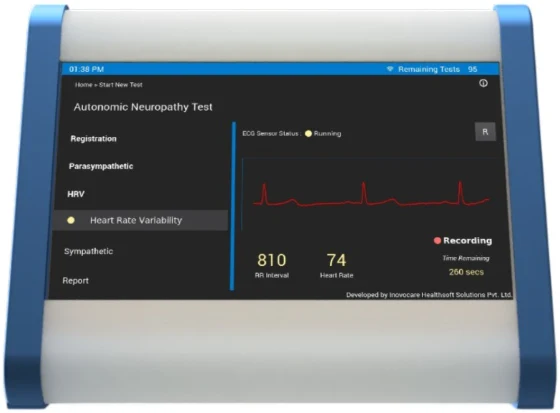
Heart rate variability recording in progress, with the live trace, RR interval, heart rate and time remaining
HRV recording
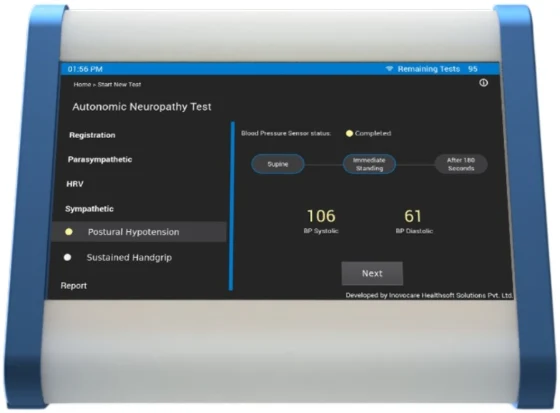
Postural hypotension test showing its three modes and the blood pressure captured for the current one
Sympathetic tests
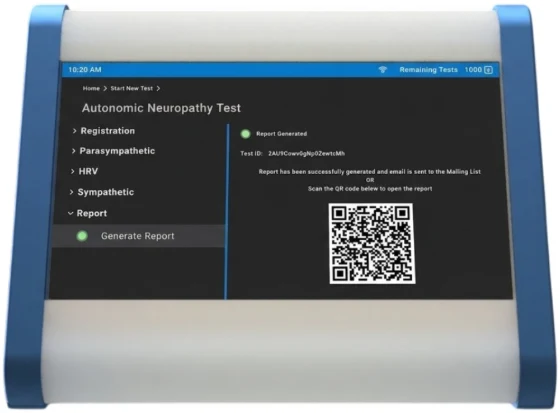
Report generated for the session, with its test identifier and a code to open the report
Report
Operator interface
The protocol, laid out the way the operator works through it.
The test tree stays on screen with each step’s state beside it. Sensor status, the live trace and the values being captured sit alongside, and the session ends with the report generated on the instrument itself.
04 / Where it stands

A bench prototype, now an instrument going into hospitals.

Before
Hardware wired up on a bench, working just well enough to show the idea.
After
A standalone instrument that runs the full battery on its own screen, repeatable enough to assemble in numbers.
Next
Units installed for hospital trials, with the client’s clinical validation and approvals continuing.

Have a prototype that needs to become a product?

Tell us what you are working on and what you need help with.

Start a Project