Start a Project
What we do
Capabilities Services Industries
Work
Company
About Careers Contact
Start a Project
Selected work 08

AI-enabled environmental monitoring for sterile healthcare environments.

An environmental sensing platform developed to continuously monitor temperature, humidity and gas response in sensitive healthcare environments. The system combined multi-parameter sensing, application-specific machine learning and remote monitoring to identify environmental patterns associated with conditions favourable to microbial growth. Taken from concept to a working prototype.
Client
Internal product development
Industry
Healthcare and environmental monitoring
Stage at start
Concept
Volvix Systems role
Embedded systems, environmental sensing, connectivity and monitoring
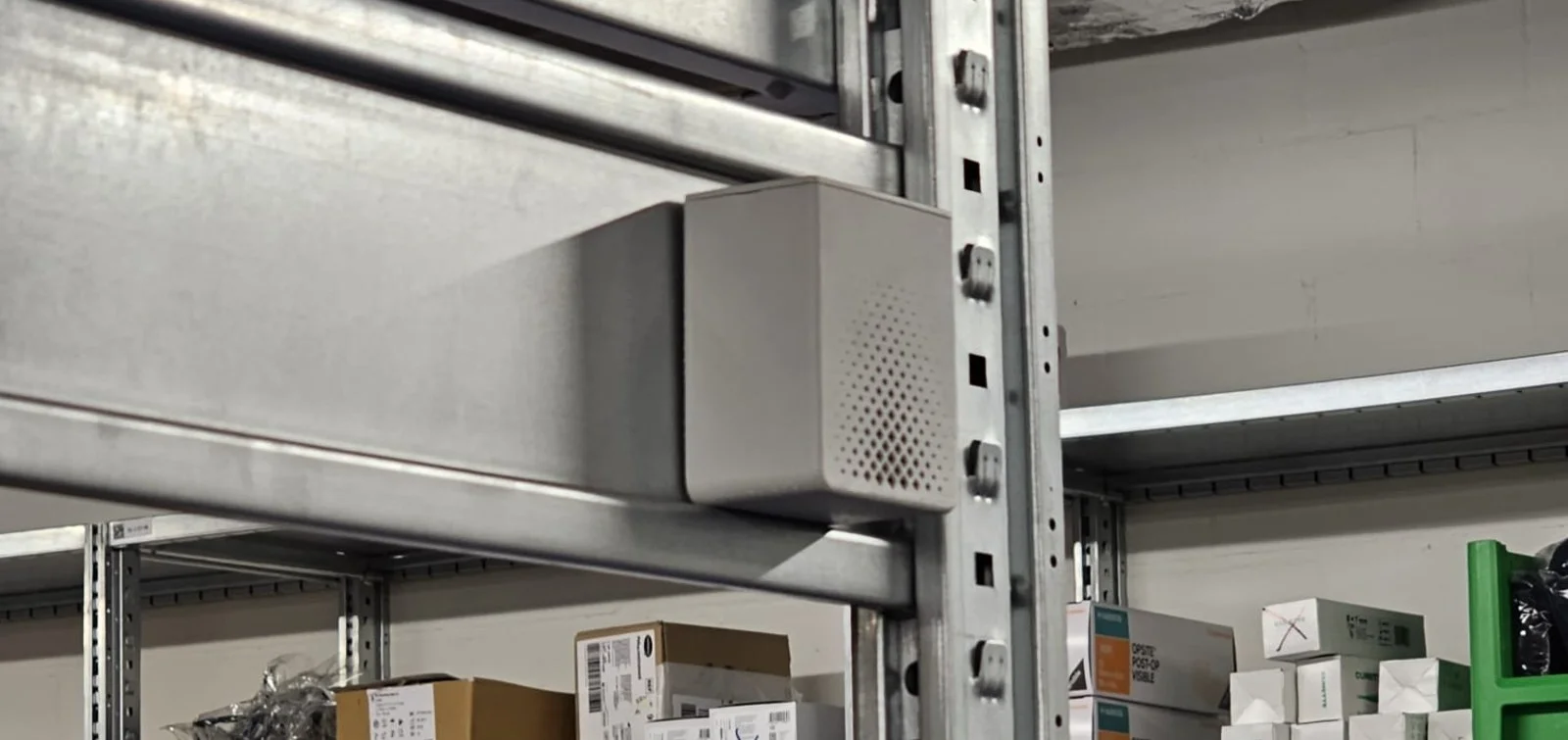
The sensing node mounted on shelving in a sterile supply store
PROTOTYPE UNIT SITED IN A STERILE SUPPLY STORE FOR DATA COLLECTION
01 / The brief

Continuous environmental monitoring, rather than periodic checks.

Rooms that hold sterilised surgical instruments and other condition-sensitive stock are checked, but they are checked periodically. A reading taken on a walk-round says what the room was doing at that moment and nothing about the hours either side of it.

Volvix Systems set out to observe those rooms continuously instead: establish what normal looks like for a given space, then report meaningful deviation from it. That shifts the engineering problem from taking accurate measurements to holding a stable baseline over months on battery power.

02 / The problem

Environmental conditions change before anyone sees the consequence.

Temperature, relative humidity and air composition are always moving. A single reading rarely tells the whole story. What matters is how those conditions change together and how long a particular pattern persists.

The product concept was to establish a learned baseline for each space and continuously compare temperature, humidity and gas response against it. Persistent changes in that combined profile could then be flagged as conditions associated with elevated microbial growth risk.

The gas sensing element responds to volatile compounds, while the environmental sensors provide the surrounding context. Together, these measurements form a multi dimensional environmental profile that can be compared against the learned behaviour of the space.

Ownership
Developed in house. The design and all intellectual property arising from it are held by Volvix Systems.
03 / What we did

Volvix Systems built the sensing hardware, embedded software and monitoring pipeline, and established the classification workflow behind the intended risk indicator. The work was carried out as internal product development.
01Multi parameter sensing — A single sensing element measures temperature, relative humidity, barometric pressure and gas response, allowing each measurement to be interpreted alongside the environmental conditions surrounding it. 02Gas response characterisation — The gas sensing element produces a response pattern across its heater profile. That response was characterised against known environmental conditions to build a usable basis for classification. 03Machine learning workflow — Response data was collected and labelled, then used to train and evaluate a classification model with the sensor vendor’s model building tools. The workflow established a relationship between the measured environmental profile and the resulting classification. 04Embedded sensing node — A compact battery powered node takes periodic measurements and sleeps between readings. At a 30 minute reporting interval, the design targets approximately one year of operation from three AA cells. Magnetic mounting allows the unit to be positioned and repositioned without tools. 05Monitoring pipeline — Readings are transmitted to a locally hosted monitoring platform rather than a third party service, keeping the data within the operator’s network. Trends, historical data and node status are presented through a dashboard. 06Environmental risk indication — The intended output is a learned environmental risk indicator generated from the combined temperature, humidity and gas response profile. Changes that match patterns associated with elevated microbial growth risk are surfaced as an actionable environmental alert.
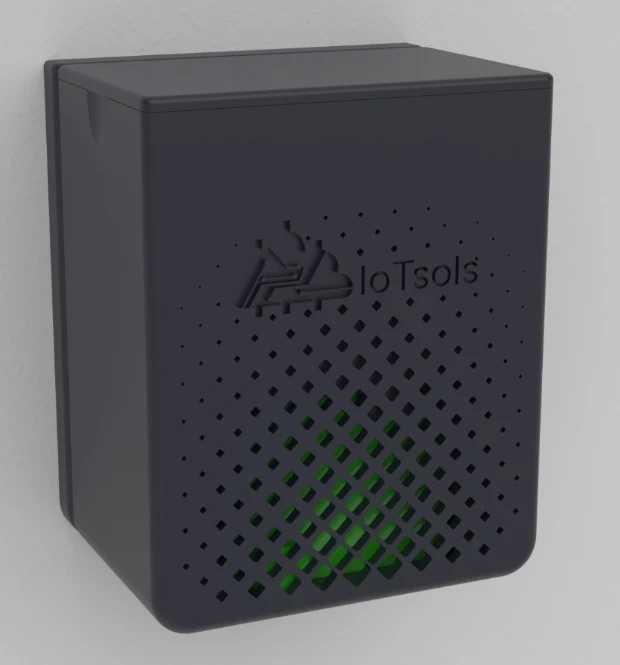
The sensing node, showing the diffusion grille over the sensing element
Multi-parameter environmental sensing
Temperature, relative humidity, pressure and gas response from one element.
A humidity figure on its own is ambiguous. Read alongside temperature, pressure and gas response, the same figure can be acted on.
Parameter
Range
Resolution
Accuracy
Temperature
−40 to 85 °C
0.1 °C
±0.5 °C
Relative humidity
0 to 100 % RH
0.1 % RH
±3 %
Pressure
Barometric
Gas and VOC response
Response pattern
AI-assisted gas classification
Response patterns as the input, not a contaminant reading.
Application-specific gas-response patterns were used as the basis for a classification workflow, with environmental variables providing additional context for the resulting risk indication.
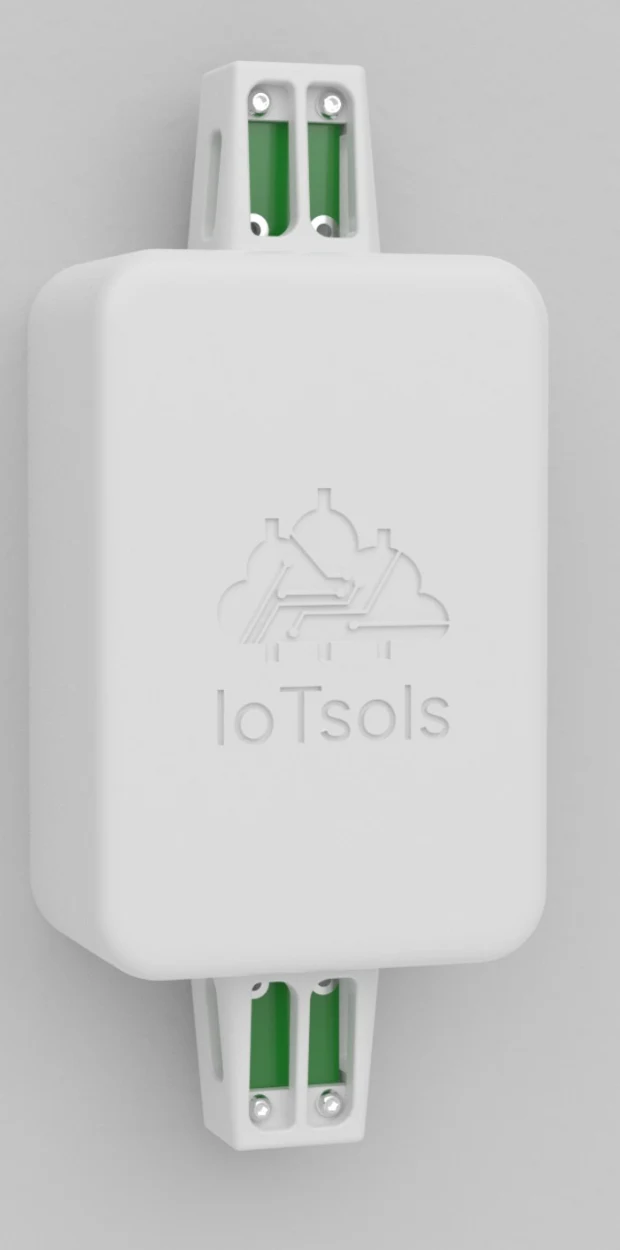
The node with its magnetic mounting plate and battery compartment
Low-power sensing node
One year on three AA cells, reporting every 30 minutes.
Service interval follows from the duty cycle. Reporting every 30 minutes holds a year of battery life, and magnetic mounting means a unit can be sited without tools.
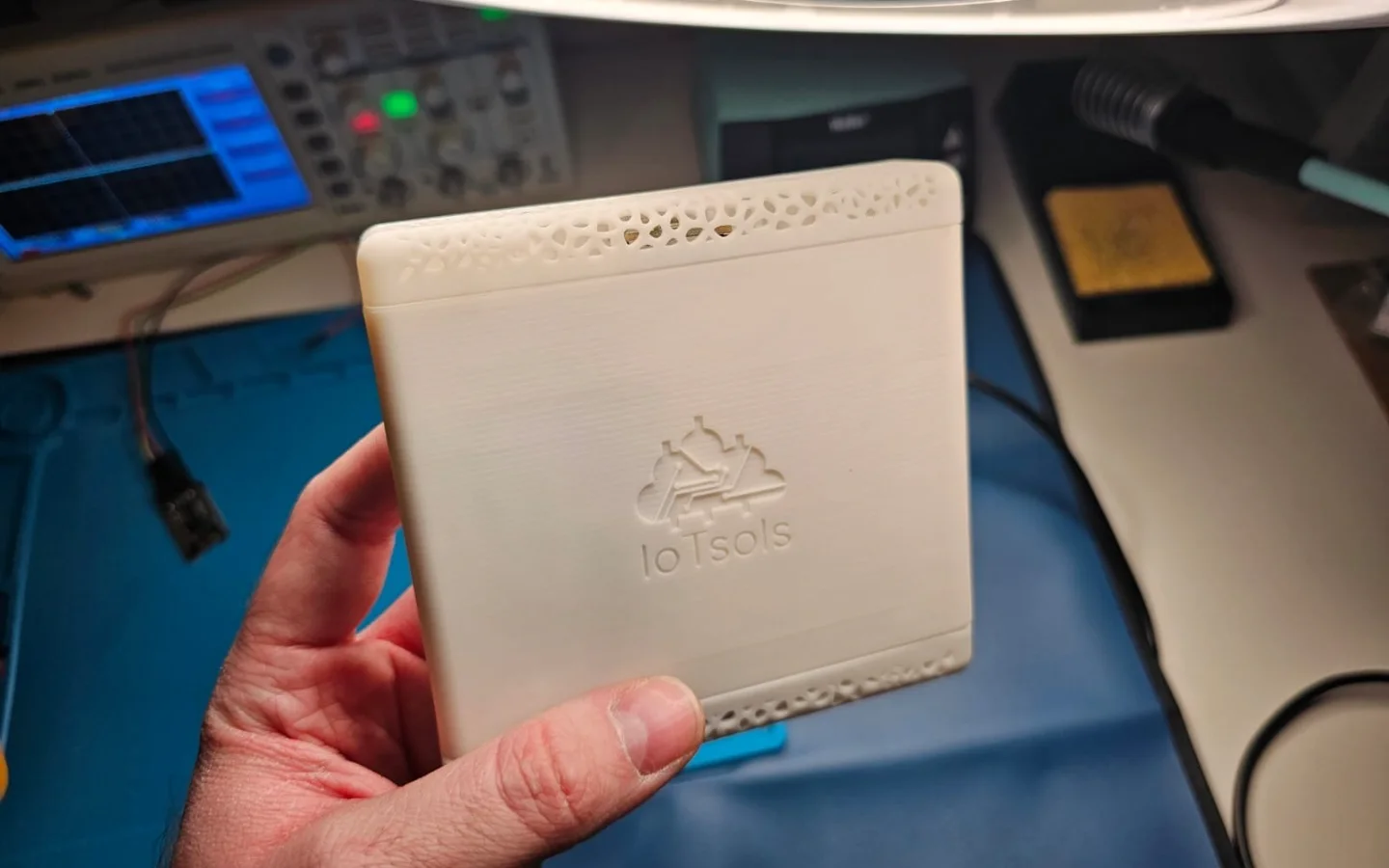
The printed enclosure held at the bench, with an oscilloscope and soldering station behind
FIG. 01 — PRINTED ENCLOSURE AT THE BENCH, DIFFUSION VENTS ALONG THE TOP AND BOTTOM EDGES
04 / Where it stands

A working prototype, stopped short of the validation the claim would need.

Prototype
A compact environmental sensing node with multi-parameter sensing, gas-response characterisation and a working monitoring pipeline.
Intended use
Continuous monitoring of sensitive healthcare environments, where persistent deviation from the established baseline may warrant investigation.
Next
Controlled data collection, model validation and field testing would be required before any claim is made about real-world microbial-growth prediction.

Have a product or system you’re trying to build?

Tell us what you are working on and what you need help with.

Start a Project